
Full-Arch Restoration, Explained
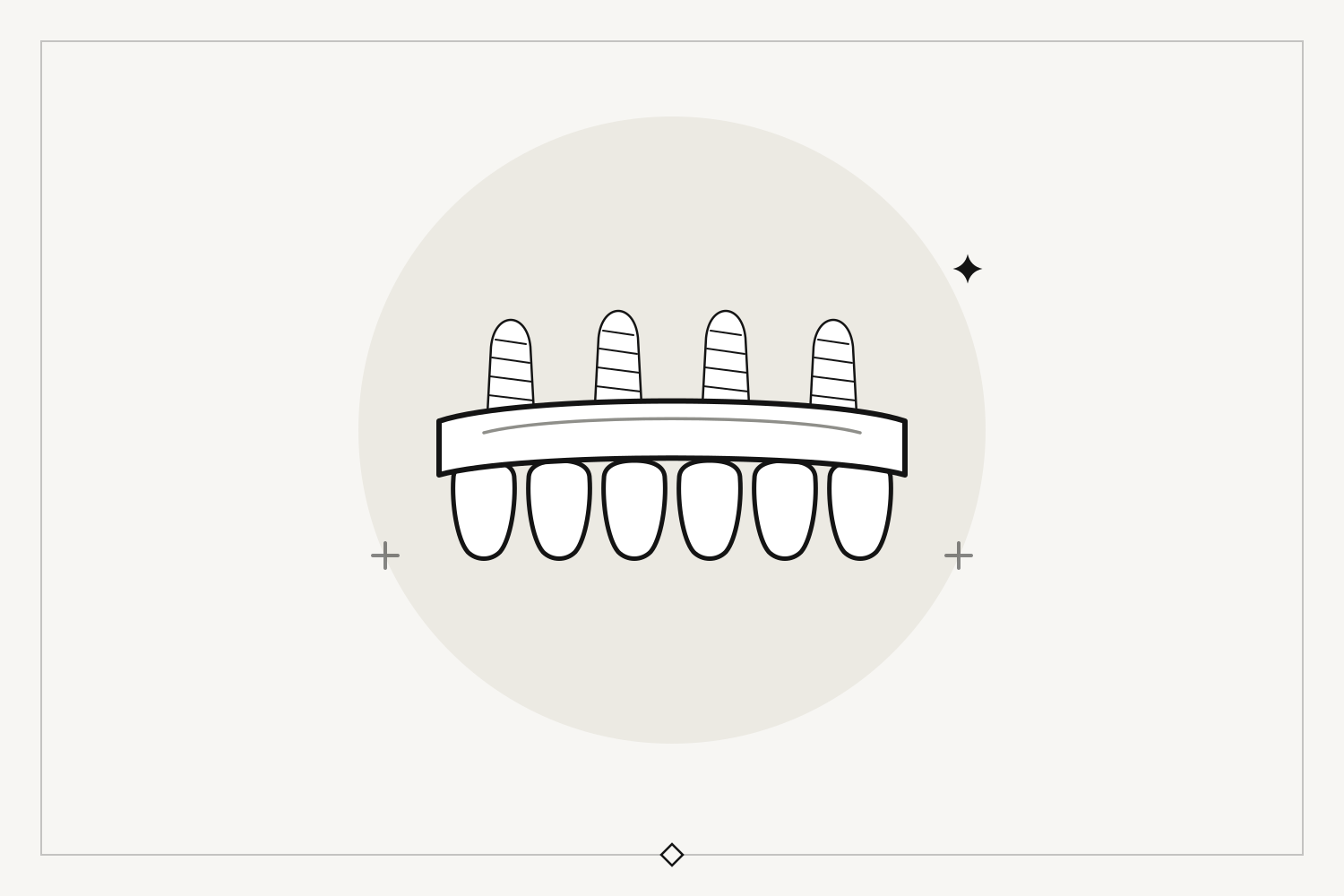
When several teeth are failing at once, treating them one at a time can mean years of patchwork: a crown here, an extraction there, a partial denture in between, and a running total that quietly passes what a definitive solution would have cost. Full-arch restoration takes a different approach. It rebuilds the entire upper or lower arch on a small number of dental implants, giving you a complete set of fixed, natural-looking teeth that are not removed at night and do not rest on your gums.
It goes by a lot of names. Full-arch restoration, full-mouth reconstruction, implant-supported bridge, fixed hybrid prosthesis, and the various branded “teeth in a day” programs are all describing versions of the same underlying idea. Understanding what actually happens, and in what order, is the fastest way to tell a good plan from a sales pitch.
What full-arch restoration actually is
A conventional denture rests on the gums and is held in place by suction, adhesive, and hope. It presses on tissue that was never designed to carry chewing force, which is why it slips, why it causes sore spots, and why it slowly gets looser: the bone underneath, no longer stimulated by tooth roots, resorbs away year after year.
Full-arch restoration moves the load off the gums and back onto the bone, where it belongs. Four to six implants (occasionally more, depending on your anatomy) are placed into the jaw, and a single fixed bridge of teeth is anchored to them. You do not take it out. You do not use adhesive. You bite with something close to natural force, and because the implants transmit that force into the bone, the bone has a reason to stay.
The word to hold onto is fixed. There is a middle option, the implant-retained overdenture, which snaps onto two or more implants and still comes out for cleaning. It is a genuine improvement over a conventional denture and it costs considerably less than a fixed arch. It is also a different treatment, and the distinction between “snaps on” and “stays in” is the single most important question to ask about any quote you are given.
Who it helps, and when saving teeth is still the better plan
Full-arch restoration is usually the right conversation when most of an arch is already lost or clearly failing: advanced periodontal disease with mobile teeth, widespread decay in teeth already heavily restored, long-standing dentures that no longer fit, or a set of teeth that have been repaired so many times there is little sound structure left.
It is not the answer to a mouth that can be saved. If you have a handful of good teeth with healthy bone around them, treating those individually and replacing only what is missing is more conservative, keeps your own roots working, and usually costs less. A practice that recommends clearing an arch that could be treated is answering a question you did not ask. Your own teeth, when they are healthy, are better than anything we can make.
The honest test is whether the remaining teeth have a predictable future. Two or three sound teeth scattered across an arch can complicate a full-arch plan more than they contribute, and there is a real judgment call there. It should be explained to you in those terms, with the reasoning visible, rather than presented as obvious.
Planning comes before surgery, and it is most of the work
The part that determines your result happens before anyone picks up an instrument.
We take a CBCT scan, a three-dimensional image of your jaw that shows exactly where the bone is dense enough to hold an implant and exactly where the nerve and sinus sit. We take digital scans of your mouth and photographs of your face at rest and smiling. From those we design the smile first, deciding where the teeth should be for your face, your lip line, and your bite, and only then work backwards to where the implants must go to support them.
That order matters more than anything else in this article. An implant placed where the bone is most convenient, with the teeth designed around it afterward, produces an arch that is technically well-anchored and looks wrong. Planning the teeth first and the implants second is what makes the difference between a restoration that reads as dental work and one that simply reads as your face.
Because our laboratory is in the same building, the surgeon and the prosthodontist plan the case together, from the same scan, at the same table. When the design is agreed we print a custom surgical guide, a template that fits over your jaw and directs each implant to the exact position and angle that were planned.
Surgery day, and what “teeth in a day” really means
On the day, any failing teeth are removed, the sites are cleaned, the implants are placed through the surgical guide, and in most cases a fixed provisional arch is attached before you go home. You leave with teeth. That is the part the branded programs are describing, and it is real.
What it does not mean is that you leave with your final teeth. The provisional arch is a genuine fixed bridge and you will eat and speak and be photographed in it, but it is made of a softer material and it is deliberately not the end point. It carries you through healing while the bone does its work, and it lets everyone see the design in your face for several months before anything is made permanent, which is a considerable advantage.
Sedation is led by board-certified MD anesthesiologists here, with recovery nurses monitoring you afterward. For a procedure of this length, that is worth asking about wherever you go, because full-arch surgery is not a short appointment and comfort during it is not a luxury.
Healing, then the final arch
Over the following months, the implants osseointegrate: bone grows directly onto the implant surface until the two are effectively one structure. This is biology and it cannot be rushed. Depending on bone quality and whether grafting was needed, expect somewhere in the range of three to six months, and expect your surgeon to give you a number specific to your case rather than a brochure figure.
You will be seen through that period. The provisional gets adjusted as swelling settles and as you tell us what is working. Those adjustments are data: every note about a sound you cannot quite make, or a place that catches when you chew, feeds into the final design.
When integration is confirmed, the final arch is made. Zirconia is a solid ceramic, extremely strong, highly stain-resistant, and the usual choice for a definitive result. A hybrid arch uses acrylic teeth on a titanium framework, is gentler on an opposing natural arch, and is more straightforward to repair, but will show more wear over the years. Which suits you depends on what is in the opposing jaw, how heavily you grind, and what you want to prioritize. Both are made in our lab, fitted here, and adjusted with you in the chair rather than mailed back and forth.
What drives the cost
We do not publish a price for this, because a number without a plan behind it is not information. What we can tell you is what moves it, so you can read any quote intelligently.
The main factors are how many implants your anatomy requires, whether one arch or both are being treated, whether bone grafting or a sinus lift is needed before implants can be placed, the material of the final arch, and the type of anesthesia. A quote that is dramatically lower than others usually differs on one of those, most often by being an overdenture rather than a fixed arch, by counting only the provisional, or by excluding the extractions and grafting as separate charges.
Ask for the total, in writing, covering surgery through final delivery, and ask what happens to the price if something is found mid-treatment. Ask specifically whether the final arch is included. That single question separates most confusing quotes.
Living with a full arch
You clean under it. That is the main adjustment, and it is not optional. A fixed arch sits slightly above the gum with a deliberate space beneath it, and that space needs a water flosser and a threader daily, because the implants can still lose the bone around them if the tissue is left inflamed. Peri-implantitis is the implant equivalent of gum disease, and it is the main long-term reason implants fail.
Beyond that, you eat normally, including things dentures made impossible. You come in for maintenance visits where the arch is checked, the fit of the screws verified, and the whole thing professionally cleaned. Well-planned implants routinely last decades. The prosthesis on top is a manufactured object and may need repair or replacement in that time, which is worth knowing at the start rather than discovering later.
Whether it is right for you
If you are living with loose dentures, widespread decay, or teeth that can no longer be saved, a consultation will tell you where you actually stand. We examine, take the imaging, and lay out the options including the ones that are not this, because for some people the right answer is periodontal treatment and a few individual implants rather than clearing an arch.
At Destination Dental in Hauppauge, the surgery, the anesthesia, the prosthetics, and the laboratory are all in one building, which is why the planning and the final fit stay in the same hands from start to finish. To talk it through, call us at (631) 360-0266 or request a consultation online.
More from the journal
Book your visit.
New patients, families, and referrals are always welcome.