
Filling or Crown? How Dentists Decide What a Damaged Tooth Needs
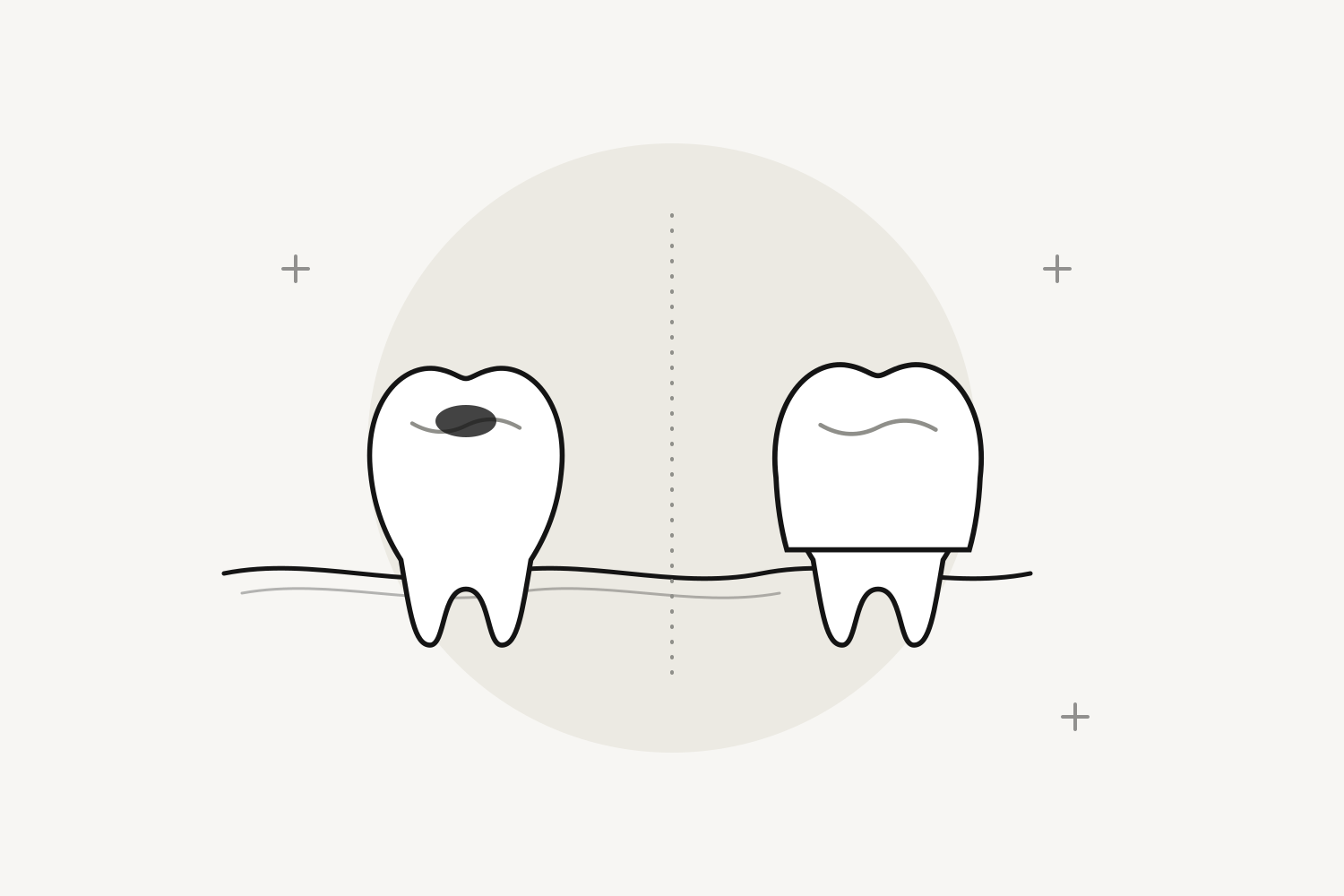
Two cavities can look almost identical in a mirror, and one gets a filling while the other gets a crown. It is a fair thing to question, especially when one option takes longer and costs more. The difference is not about the size of the hole you can see. It is about how much healthy tooth is left around it.
What a filling does, and what it does not
A filling replaces the part of the tooth that decay destroyed. The decay is removed, and the space is filled, usually with a tooth-colored composite bonded to the tooth.
What a filling does not do is reinforce the tooth around it. It relies on the remaining walls of natural tooth to carry the force of chewing. When those walls are thick and strong, a filling is a conservative, durable repair. When they are thin, the filling holds, but the tooth around it becomes the weak point.
What a crown does
A crown covers the entire visible part of the tooth, like a cap. Because it wraps all the way around, it holds the tooth together and spreads biting force across the whole thing. That is why crowns are used for teeth that are cracked, heavily filled, or broken, and why a crown is the usual fix in our article on cracked teeth that hurt when you bite.
The tradeoff is that the tooth has to be reshaped on all sides to make room for the crown. Healthy tooth structure is valuable, so a crown is the right call when the tooth needs protection, not simply because it is the stronger option.
The middle option: an onlay
An onlay covers and reinforces one or more cusps, the raised corners of a back tooth, without covering the whole tooth. It fits the case where a filling would be too large to be safe but the rest of the tooth is sound. Many people have never heard of onlays, and they are often the most conservative way to protect a tooth that is partly weakened.
How the decision is made
Most of the decision happens with the tooth open, once the decay or old filling is out and the remaining walls can be seen and assessed. The things we look at:
- How much tooth is left. If a large share of the chewing surface is gone, a filling would be doing too much of the work.
- The thickness of the remaining walls. Thin walls flex under biting and are prone to cracking.
- Whether a cusp is cracked or missing. A cusp that has broken or is cracking needs to be covered.
- Cracks elsewhere in the tooth. A crack can be visible only once the tooth is open.
- Where the tooth is and how hard you bite. Back teeth carry the most force, and people who grind or clench put extra stress on large fillings. Our piece on teeth grinding and night guards explains why.
- Treatment inside the tooth. A back tooth that has had treatment of the nerve is usually crowned afterward, because it is more brittle.
Sometimes the plan changes in the chair. A cavity that looked like a filling on an X-ray turns out to have undermined more of the tooth than expected. When that happens, we stop and explain what we found before going further.
Why a big filling often becomes a crown later
A common story: a tooth gets a filling, then a larger one years later, then one day a corner of the tooth breaks off while eating. Each time the filling is replaced, a little more tooth is removed, and the walls around it get thinner. Eventually there is not enough tooth left to support another filling.
Recommending a crown on a heavily filled tooth before it breaks is not upselling. A tooth that cracks can sometimes still be crowned, but a tooth that splits through the root often cannot be saved and may need to be replaced with an implant. Protecting it while it is still intact is almost always simpler.
Crowns made in our own lab
Waiting weeks in a temporary crown is one of the reasons people put crowns off. At our Hauppauge office, crowns are designed and made in our in-house laboratory, so in many cases a tooth can be prepared and crowned in a single visit. Our article on same-day crowns explains how that works.
Fillings and crowns in Hauppauge, NY
The best repair is the smallest one that will still hold up. Sometimes that is a filling, sometimes an onlay, sometimes a crown, and you should always understand why one is being recommended.
If you are in Hauppauge, Smithtown, Commack, Islandia, or anywhere in Suffolk County, call us at (631) 360-0266 or request an appointment online. Our general and restorative team will show you what we see and walk you through the options.
Frequently asked questions
How does a dentist decide between a filling and a crown?
It comes down to how much healthy tooth is left once the decay or old filling is removed. A filling works when strong walls of natural tooth remain to support it. When the walls are thin, a cusp is cracked or missing, or a large share of the tooth is gone, a crown or onlay is needed to hold the tooth together under biting force.
Why would a tooth with a filling need a crown?
A filling replaces missing tooth but does not reinforce what is left. A very large filling leaves thin walls of tooth around it, and those walls can crack under chewing over the years. A crown covers and protects the whole tooth so it does not split.
What is an onlay, and is it a middle option?
Yes. An onlay is a custom-made restoration that covers and strengthens one or more cusps of the tooth without covering the whole thing. It is a good choice when a filling would be too large but the rest of the tooth is strong enough that a full crown is not needed.
Is a crown always better because it is stronger?
No. A crown requires reshaping more of the tooth than a filling does, and healthy tooth structure is worth keeping. The right repair is the most conservative one that will still hold up. For a small or moderate cavity, a filling is usually the better choice.
How long does it take to get a crown?
Traditionally a crown takes two visits with a temporary in between while a lab makes it. Because our crowns are designed and made in our own in-house laboratory, in many cases a crown can be completed in a single visit.
More from the journal

Book your visit.
New patients, families, and referrals are always welcome.